
CPTPP accession and development: What does Cambodia’s case reveal about regulatory gaps and reform priorities?
Written by: Minako Morita-Jaeger
Expectations from the Comprehensive and Progressive Agreement for Trans-Pacific Partnership (CPTPP) are rising amid intensifying geopolitical uncertainty, growing US protectionism, pressure on its trading partners, and the continued deadlock in World Trade Organization reform. To date, 12 countries from different regions have formally applied to join the CPTPP.[1]
Many of these applicants are developing countries. Acceding members are expected to comply fully with all existing CPTPP rules. This requires a clear understanding of the regulatory obligations involved, identification of gaps between CPTPP provisions and domestic legal frameworks, and careful consideration of how these rules align with national development strategies.
Cambodia as a case study of accession challenges
The UKTPO recently produced a report for the FCDO assessing the case of Cambodia, which applied to join in December 2025. In particular, it focuses on the regulatory gaps between the CPTPP’s e-commerce and environment chapters and Cambodia’s legal framework, identifies compliance risks, and highlights reform priorities as the country prepares to graduate from Least Developed Country (LDC) status in 2029.
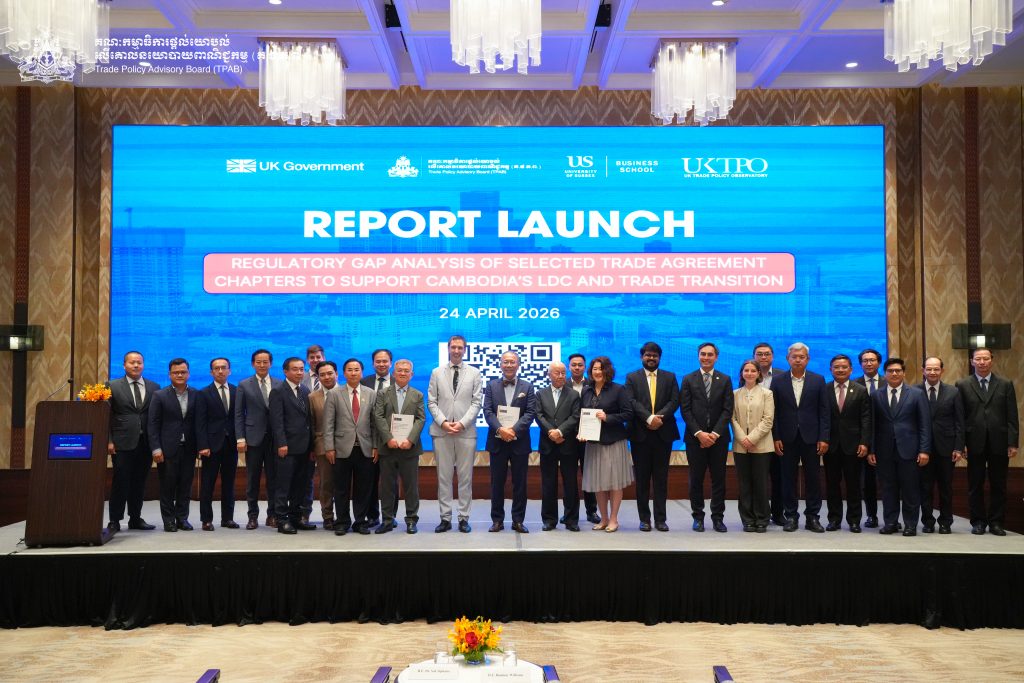
The report launch event in Phnom Penh (24 April 2026)
The analysis finds that compliance gaps reflect both Cambodia’s regulatory constraints and the CPTPP’s mixed structure of binding and more flexible commitments.
Digital trade rules: Gaps in data governance
The CPTPP e-commerce chapter establishes high-standard, market-oriented rules for digital trade, alongside relatively light “trust-building” obligations such as data privacy. The report finds that Cambodia’s main gaps lie in cross-border data governance. Existing laws allow strong state control over data and may restrict cross-border transfers, potentially conflicting with CPTPP provisions. By contrast, gaps are smaller in areas such as consumer protection, cybersecurity, and data privacy as the CPTPP requirements are relatively flexible. E-commerce facilitation measures, including electronic transactions and digital signatures, are broadly aligned.
Aligning with CPTPP standards will require carefully sequenced reforms, balancing openness with domestic priorities, and strengthening institutional capacity. Addressing infrastructure gaps, improving digital inclusion, and building public trust will be essential.Top of Form
Environmental rules: Fisheries as the key compliance challenge
The CPTPP environment chapter is one of the most comprehensive among existing Free Trade Agreements (FTAs) that include an environment chapter, although it relies in part on cooperative language and contains limited provisions on climate change.
Cambodia’s most significant regulatory gap lies in fisheries management. The CPTPP requires detailed, science-based disciplines on subsidies, bycatch reduction, stock recovery, and species conservation. Cambodia’s current framework remains general and lacks clear prohibitions on subsidies linked to Illegal, Unreported and Unregulated (IUU) fishing and overfished stocks. This makes fisheries the highest compliance risk and a priority for reform.
Other areas -such as invasive species, environmental goods and services, and low-emissions transition- are largely cooperation-based and pose lower compliance risks. Corporate social responsibility provisions are also flexible, though Cambodia lacks a clear framework to promote voluntary environmental practices.
Policy priorities and reform pathways
The report recommends a phased reform strategy focused on strengthening digital and sustainable ecosystems through investment in infrastructure, skills, and technology. Priorities include developing interoperable data governance frameworks, limiting unnecessary data localisation, and enhancing consumer trust. Fisheries reform is also critical, particularly in addressing harmful subsidies and improving science-based management.
Cambodia should also strengthen its regulatory clarity, institutional capacity, transparency, stakeholder engagement, and inter-agency coordination. The United Kingdom is well placed to support this transition through technical assistance in data governance, cybersecurity, and sustainable fisheries, as well as through regulatory partnerships that facilitate knowledge transfer and capacity building.
What Cambodia tells us about the future of the CPTPP
The Cambodia case highlights the importance for developing countries of aligning their accession with long-term development strategies. As the CPTPP was not originally designed with developing countries in mind, applicants must carefully assess how each chapter fits their economic and regulatory priorities. Although the CPTPP is regarded as a high-standard FTA, its chapters vary in their specific features. Developing countries that have applied to join the CPTPP could use this report to understand potential areas of regulatory reforms that may accompany accession.
At the same time, existing CPTPP members should examine expansion from a development perspective. Accession should not be viewed solely as a process of rule alignment. Each chapter carries distinct implications, and further research is needed on the future evolution of the CPTPP as a framework that accommodates development needs.
[1] These countries include: China, Taiwan, Ecuador, Costa Rica, Uruguay, Ukraine, Indonesia, Philippines, UAE, Cambodia Thailand and Colombia.
Disclaimer:
The opinions expressed in this blog are those of the author alone and do not necessarily represent the opinions of the University of Sussex or UK Trade Policy Observatory.
Republishing guidelines:
The UK Trade Policy Observatory believes in the free flow of information and encourages readers to cite our materials, providing due acknowledgement. For online use, this should be a link to the original resource on our website. We do not publish under a Creative Commons license. This means you CANNOT republish our articles online or in print for free.